Memory Match Training: Sharpen Your Recall One Pair at a Time
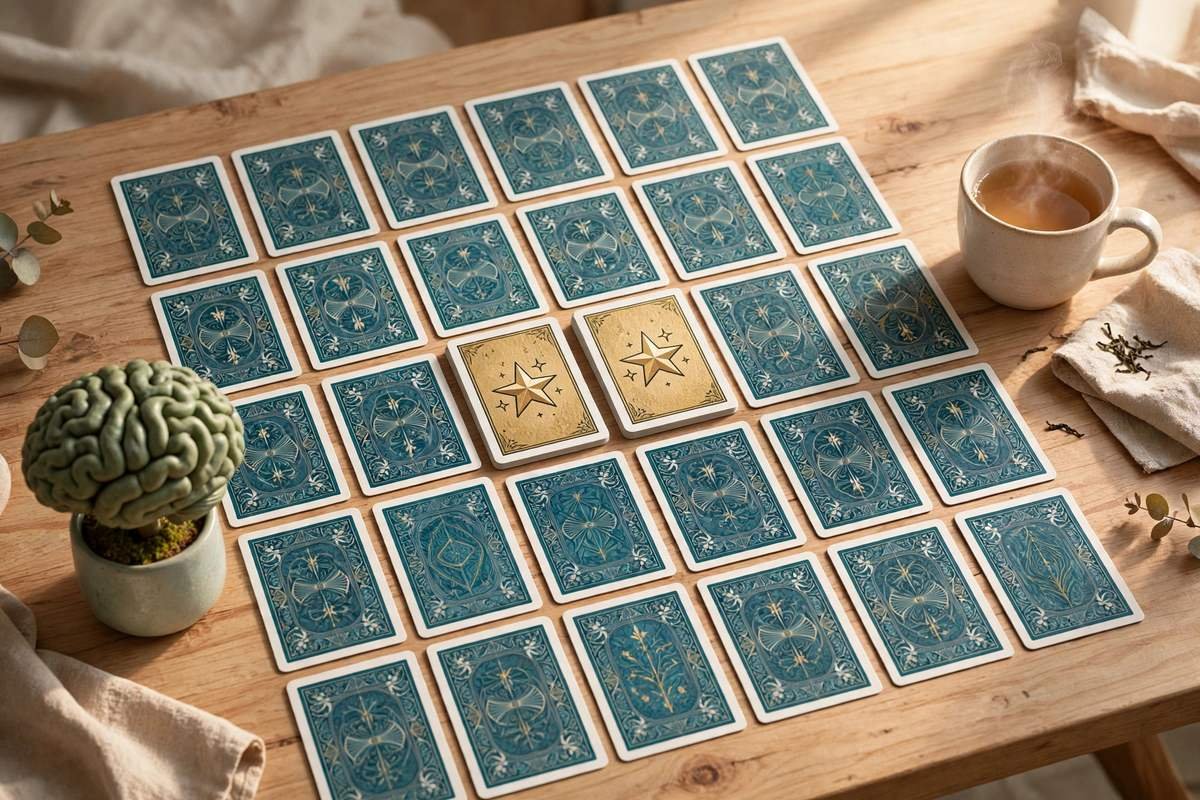
I have a terrible memory for names. I can meet someone, shake their hand, and forget their name before we've finished saying hello. But I can remember the position of thirty-two cards on a grid after flipping them once. That contradiction used to bother me until I realised something: memory isn't one big talent, it's a set of small skills — and matching games train the most useful one of all, which is noticing things properly the first time you see them.
1. Why Matching Games Work When Flashcards Don't
Flashcards feel like school. Matching games feel like play, and that difference matters more than people think. When you're relaxed and enjoying yourself, your brain pays better attention — stress narrows your focus to the threat in front of you, while play opens it up to details. That's why you can remember a card you flipped three minutes ago in a game but not a word you crammed last night.
The other reason is that matching games force you to use your memory actively. You don't just recognise something, you have to recall where it was, under pressure, with a ticking sense that the next flip might be wrong. Psychologists call this retrieval practice, and it's one of the best-studied ways to strengthen memory: the effort of pulling something out of your head is what makes it stick. Every time you flip a card and think "I've seen this — bottom row, second from the right," you're doing a tiny rep of exactly that.
Play Memory Match Masters for ten minutes and notice what your brain is actually doing: it's not memorising pictures, it's memorising places. The picture is just the label on the place. That place-memory — spatial memory — is the same skill you use to remember where you parked the car or where you left your keys. Training it in a game trains it everywhere.
2. The Corner-First Scan: Give Your Memory Landmarks
Here's the technique that changed my game completely. When you start a new board, don't flip cards at random. Flip the four corners first, then the middle of each edge. Corners and edges are landmarks — your brain remembers positions near landmarks far better than positions floating in the middle of nowhere, because it can picture them: "top-left corner," "bottom edge, near the middle."
Think about how you remember rooms in a house. You don't remember "the chair was 1.4 metres from the north wall" — you remember "the chair was by the window." Landmarks do the heavy lifting. Cards near the corners of the board work the same way. Once you know the corners, work inward in pairs: two cards from the left side, two from the right, and so on. Each pair gets anchored to a side your brain already knows.
Try it for a week and compare your scores. Most people cut their mismatches by a third in the first few days, not because their memory improved but because they stopped asking it to do the hardest possible job — remembering random positions with no anchors. Give your memory landmarks and it will surprise you.
3. Say It Out Loud (Even in Your Head)
This one feels odd, but it works: when you flip a card, say what and where it is. "Star, top row, third from the left." Saying it forces your brain to process the card twice — once through your eyes, once through language — and two encodings beat one every time. You don't need to speak aloud if you're on a bus; saying it silently in your head does most of the job.
It also slows you down in a useful way. The classic matching-game mistake is flipping the next card before you've properly registered the last one. Your eyes saw it, but your brain never filed it. A half-second of naming the card gives your brain time to file it properly. I think of it as the difference between glancing at a house number as you drive past and actually reading it out: one vanishes instantly, the other stays.
Combine this with the corner-first scan and you get something powerful: a mental map of the board, described in words, anchored to landmarks. After a few rounds you'll find yourself knowing where cards are without even trying — the map just appears in your head. That's not a trick. That's your memory doing what it was built to do, given a fair chance.
4. Chunking: Remember Groups, Not Cards
Your short-term memory can hold roughly four to seven things at once — not thirty-two. So if you try to remember every card individually, you'll overflow. The solution is chunking: grouping cards into a few meaningful units instead of many meaningless ones. "The two stars are in the top corners" is one chunk. "The hearts are both on the left edge" is another. Four chunks cover the whole board.
Here's a worked example from a real game of Memory Match Masters. The board has sixteen cards. In my first pass I find a pair of moons — one top-left corner, one bottom-right corner. That's a chunk: "moons in opposite corners." Then two bells, both on the right edge — "bells on the right." Then two suns, one centre-left, one centre-right — "suns across the middle." Three chunks, six cards, and I haven't even tried hard. When a moon flips up later, I don't search my memory for a needle in a haystack; I just think "moons — opposite corner" and flip it.
Children do this naturally, which is why they often beat adults at matching games: they describe what they see in simple groups instead of trying to memorise a grid. Watch a child play and you'll hear it: "the red ones are together, the blue ones are at the bottom." Copy them. Chunking isn't dumbing down — it's how memory actually works.
5. A Gentle Daily Routine for Sharper Recall
You don't need to grind. Ten minutes a day, at the same time if you can, is plenty — your brain loves routine. I'd suggest this shape: two rounds of Memory Match Masters with the corner-first scan and naming technique, then one round of something different to keep your brain flexible. Merge 2048 Deluxe is a good partner because it trains planning rather than recall, and Sliding Tile Tangle trains spatial thinking — together they cover more ground than any single game.
Keep a simple log: date, number of mismatches, best time. Not to obsess over — just to notice trends. You'll have bad days, and that's normal; tired brains forget more, and a bad day after a poor night's sleep tells you about sleep, not about your memory. Look at weekly averages instead of daily scores, and you'll see the real trend, which for most people is a slow, steady improvement over a month.
And one honest note: matching games train the kind of memory you use in everyday life — where things are, what goes with what — but they're not a cure for anything, and they won't fix a serious memory problem. If you or someone you love is worried about memory, that's a conversation for a doctor, not a game. What these games genuinely do is keep a healthy memory active, alert and well-practised. That's a modest claim, and it's a true one.
Frequently Asked Questions
Do memory matching games actually improve your memory?
They train specific skills — spatial recall, attention to detail and retrieval practice — and those skills do transfer to everyday tasks like remembering where you left things. The gains are real but modest: expect sharper everyday recall over a few weeks of regular play, not a superhuman memory. The key is playing attentively with a technique, not just flipping cards on autopilot.
What is the best strategy for memory match games?
Scan the corners and edges first to give your memory landmarks, name each card and its position as you flip it, and group what you find into chunks like "both stars are in the top corners." This combination — landmarks, naming and chunking — cuts mismatches dramatically compared to random flipping, because it works with how memory naturally stores information.
How many cards should a beginner start with?
Start small — twelve or sixteen cards — and only move up when you can clear the board with few mismatches. Jumping to a huge board too early teaches you to guess instead of remember, which builds bad habits. Small boards let you practise the corner-first scan and chunking properly, and those skills scale up to any board size when you're ready.
How long should a memory training session last?
Ten to fifteen minutes a day is the sweet spot. Memory training follows the same rules as physical training: short, regular sessions beat occasional marathons, and tired brains learn poorly. Two or three focused rounds, then stop. If you notice your mismatches climbing sharply, that's fatigue talking — take a break and come back tomorrow.
Can children and older adults both benefit from memory games?
Yes — matching games are one of the few activities that genuinely work across ages, because the core skill is the same at seven and seventy: noticing carefully and recalling where things are. Children tend to chunk naturally and often beat adults; older adults benefit from the regular, gentle exercise of recall. Just adjust the board size to the player and keep it fun — the moment it feels like a test, the benefit drops. You will find more brain-training guides on the Gomen articles hub.